If you look at LinkedIn, most everything we do in ecommerce performance marketing gets declared as “dead!” every single day.
SEO. Landing pages. Content marketing. Copywriting.
But you know what persists? You know what is never declared as obsolete?
The cart abandonment email.
It lives on! Tried! True! Usually automated within an inch of its life, but it persists!
People still add things to cart with all the conviction of someone proposing marriage, then vanish like they were drafted into a war five seconds later. They get distracted. They open seventeen tabs. They compare prices. They start doing mental math. They decide they “deserve a little treat,” then suddenly remember they also deserve rent money and a functioning nervous system.
For example, right now I would estimate that I have between seven and 35 carefully constructed carts across different ecommerce brands. The skincare, wardrobe, movie library, and obsessive Lego collection of my dreams are all just single clicks away.
But then someone said my $235 estimated subtotal would cost a deeply offensive $4.99 in shipping, and now I need to rethink everything.
These are your buyers, too. They get to shipping and feel personally insulted. They realize they don’t know what size to get. They scroll away to “think about it,” which, as we all know, is one of ecommerce’s most elegant lies.
So yes, your cart abandonment email still matters
What should have died by now is the way so many brands still write them.
You know the email.
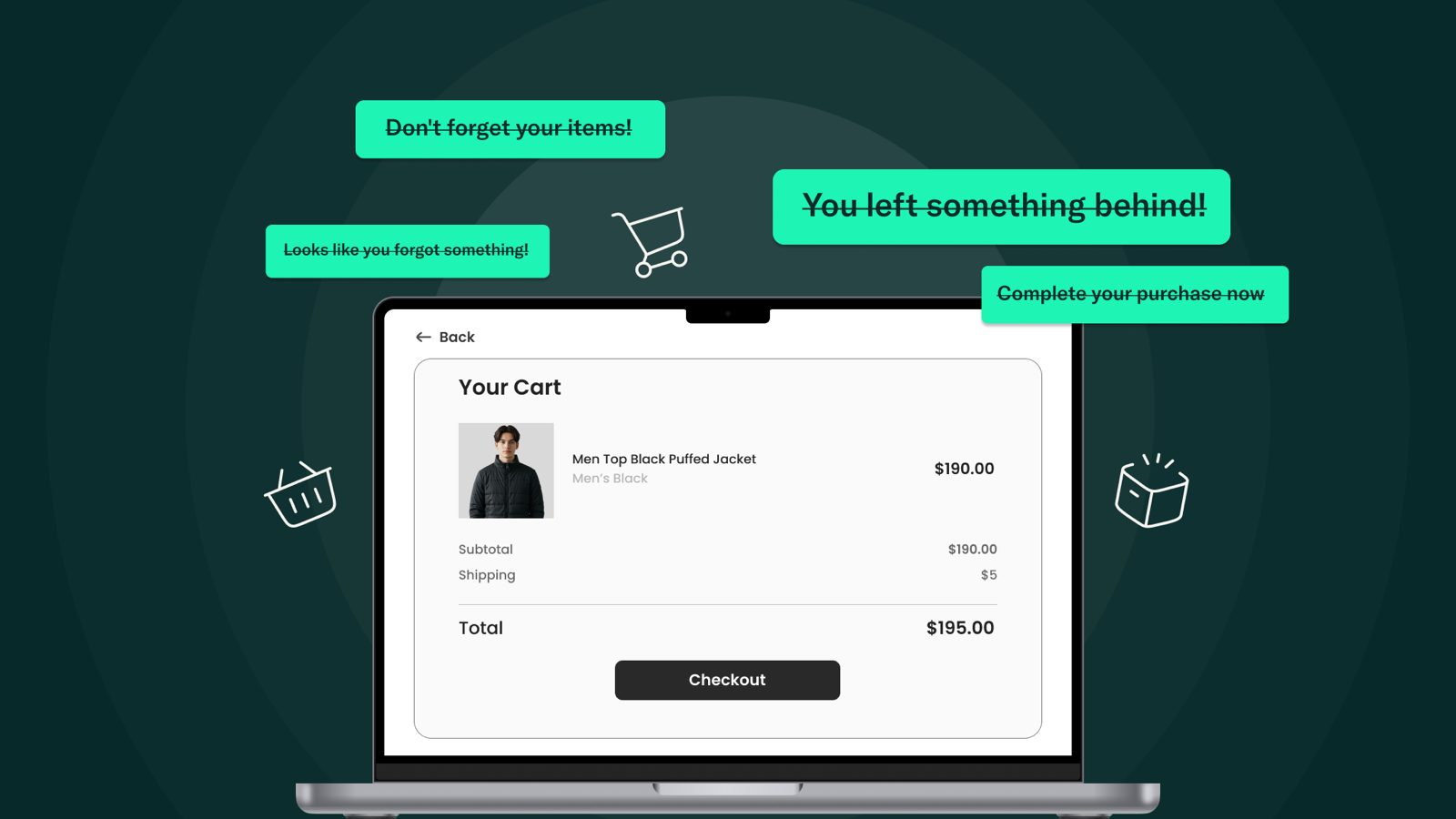
- Subject line:You left something behind.
- Preview text:Don’t forget your items.
- Body copy:Looks like you forgot something!
Giant product block. Giant button. Maybe a timer. Maybe a discount. Maybe some fake urgency with all the emotional credibility of a mall kiosk.
Look, the world isn’t going to end because I’m not buying your sweater, but for one brief moment you attempt to convince me everything is hinging on the pile of yarn you’re selling me.
And every time one of those hits my inbox, I have the same thought:
You people have learned nothing.
Because in most cases, your customer did not “forget.”
They hesitated.
That’s a very different problem. And it deserves much better writing.
That means the job is not just reminding. The job is recovering momentum.
And that, my friends, is where things get much more interesting.
Let’s start with the obvious problem: most cart abandonment emails are lazy
A bad cart abandonment email treats the shopper like a goldfish. A good one understands they are a human being who got interrupted, unconvinced, price-sensitive, overstimulated, or suspicious somewhere between Add to Cart and Buy Now.
Unfortunately, most brands treat cart abandonment like a plug-and-play automation. You build the flow, throw in a dynamic product block, write some chirpy subject line that sounds like a substitute teacher trying to seem “chill,” and call it lifecycle marketing.
Then everybody acts shocked when the performance is mediocre.
But mediocre performance is exactly what you should expect when the email is built on a mediocre premise.
If the whole strategy is “customer left, so let’s remind them the cart exists,” you’re already behind. They know the cart exists. They were there. That’s how carts work. This is not a mystery novel.
This is where you need to start asking questions:
- Did they get distracted?
- Did the price start feeling heavier at checkout?
- Did shipping make the total weird?
- Were they comparing you to something else?
- Did they lose confidence?
- Did the product start feeling unnecessary instead of must-have?
- Did your site ask them to create an account and suddenly turn a simple purchase into a part-time job?
Every one of those scenarios asks for slightly different persuasion, which is why so many cart abandonment emails fail. Most are technically relevant (“Your cart is still here, but you are long gone!”), but emotionally and strategically useless. They re-state the moment without helping the customer move through it.
You’re not helping create a sale in those moments, you’re hovering at the doorway telling someone who is already in their car:
“Hey! Did you know you got in your car and just put the key in your ignition? Just thought you should know!”
And if your brand is hovering in my inbox with “Oopsie, did you forget something?” while I’m staring at a cart total that could cover a minor emergency, I’m not charmed. I’m annoyed.
Your first step is to stop pretending all cart abandonment is the same
Yes, segmentation takes more thought than dropping everyone into the same three-email sequence and hoping the second one with the discount does the Lord’s work.
As an inherently lazy person myself, more work bums me out. But this is the work we need to do, because it makes your emails work harder. Cart abandonment isn’t the result of a single behavior that can be captured in a single email reactivation workflow. It’s a category of behaviors.
Someone abandoning a $22 impulse beauty item based on a PPC ad they clicked isn’t having the same internal conversation as someone abandoning a $480 kitchen appliance, a $175 pair of jeans, or a $1,200 piece of furniture they now need to discuss with a spouse, a spreadsheet, and probably a priest.
Price matters. Product type matters. Urgency matters. Risk matters. Confidence matters. Whether the shopper is new or returning matters. Whether the product is utilitarian, emotional, giftable, seasonal, replenishable, or deeply size-dependent matters.
And if all of that sounds like a lot, good. It should.
Because this is where your writing gets to stop being generic. Good cart abandonment copy gets better the second it starts telling the truth about the decision in front of the shopper:
- If it’s a lower-cost impulse product, you can be lighter, faster, flirtier.
- If it’s a considered purchase, you need more reassurance and less fake cheer.
- If fit is the issue, address fit.
- If shipping is the issue, address shipping.
- If price is the issue, resist the urge to immediately throw a discount grenade at the situation unless your long-term strategy is to train your customers like raccoons.
This is why the old “just remind them” approach feels so dead now. Customers have seen too much. They know the sequence and all of your tricks. They know when a brand is actually helping them make a decision and when it is just running a dusty automation somebody set up two years ago and never revisited.
What cart abandonment emails are actually supposed to do
They are supposed to move the sale forward.
Yes, yes, I know that sounds obvious, but it’s mind-boggling to me how many brands still lose the plot over something so glaringly “obvious.”
A good cart abandonment email usually does one of four things
- Reducesfriction.
- Restoresdesire.
- Answers an objection.
- Or gives the shopper a reason to act now instead of “later” (which is the graveyard where many ecommerce purchases go to die)
Sometimes that means making the return to cart feel incredibly easy. Sometimes it means surfacing proof that this product is worth the money. Sometimes it means reducing perceived risk with reviews, guarantees, shipping information, returns, or fit guidance. Sometimes it means using urgency or incentive.
Honestly, it can “sometimes” be doing a lot of different things, but no matter what, the email should be doing persuasive work.
The moment you stop acting like cart abandonment is a static workflow trigger and start treating it like a decision point, you’re going to get more sales from those emails.
The customer was close. Close is not the same as sold. Your email has to close the gap.
Your cart abandonment email copy should sound like it understands the moment
There’s a difference between a cart abandonment email that acknowledges hesitation and one that acts like the customer’s only problem is memory loss.
The second one is lazy. The first one converts.
This is where I think a lot of ecommerce teams still get trapped in one of two bad options.
Option one: robotic utility
- Subject line says exactly what happened.
- Body copy says almost nothing, like it literally exists only to make sure the email isn’t blank.
- CTA says return to cart.
- Everybody goes home.
Option two: fake personality
- Suddenly the brand is doing a little vaudeville routine in the inbox.
- Lots of puns. Lots of “we noticed…”
- Lots of cutesy nonsense from a company that, in every other consumer touchpoint, sounds like it has a legal team and a growth team sharing one body.
Neither of these is especially good. But the second one makes me more irrationally angry, because we’re all actual human beings behind the writing of these emails… and somehow, we still end up sounding fake.
What you actually want is a brand voice with a pulse that is still in service of the sale.
That means the email can be funny, but not at the expense of clarity. It can be bold, but not random. It can be playful, but not clueless. It can have a point of view. In fact, it should. But the point of view needs to sharpen the email, not turn it into a little improv exercise.
For example, “You left something behind” is usually dead on arrival because it is both obvious and generic. It belongs to everybody and therefore nobody.
But there are a hundred stronger ways to reopen that moment depending on the product and the customer:
- If you sell premium sheets, you can lean into desire: your bed deserves better, and frankly so do you.
- If you sell cookware, you can acknowledge the considered purchase: fair enough, nobody should impulse-buy a pan set like it’s gum at checkout.
- If you sell fashion, you might go straight at hesitation around fit, styling, or returns.
- If you sell supplements or skincare, you may need to restore belief in the product instead of just showing it again.
We’re not here to be cute on command, we’re here to look contextually aware and human. That’s how you sell.
Let’s talk about the sequence, because one email is usually not enough
A single cart abandonment email can work just fine for some brands. I have an aggressive amount of face serums that prove that to be true. But in a lot of categories, one email is not enough because one email cannot do all the jobs.
You do not want your first email trying to remind, reassure, create urgency, explain returns, showcase reviews, introduce a discount, and sound charming all at the same time. That is how you end up with an overstuffed mess written by committee.
A stronger sequence lets each email have a purpose:
- The first emailusually works best when it is the cleanest. Low friction. Short path back. Minimal drama. “You were close; here’s an easy way to pick it back up.” If you overtalk that moment, you ruin it.
- The second emailis where you can do more real persuasion. This is where reviews, benefits, differentiation, fit guidance, guarantee language, or strong objection handling can earn their keep. This is where the copy should start answering the silent “yeah, but…” in the customer’s head.
- The third email is where urgency or incentive can make sense if that is actually part of your strategy. And I really mean strategy, not panic. Too many brands hand out discounts like they are paying ransom. Then they wonder why customers learn to abandon intentionally. Because you trained them, that’s why.
And if you use an offer, use it on purpose by knowing:
- What behavior you are encouraging.
- What margin you are giving up.
- Whether the product, price point, and customer type justify it.
Not every cart abandonment sequence needs a discount. Sometimes a better-written email will outperform the lazy bribe. That’s the fun part no one talks about enough. Better writing really can save you money.
Here’s where brands usually screw up cart abandonment emails
Let’s talk through a few of my favorite cart abandonment email mistakes I see all the time:
- They make the first email too busy, too cute, or too desperate. Then by the time they should actually be persuading, they have run out of steam and defaulted to “complete your purchase now” like they’re getting paid by the button.
- Or they rely on urgency they have not earned. If everything is low stock, ending soon, going fast, almost gone, last chance, final hours, and still somehow available next Tuesday, your customer is not fooled. They are just getting a masterclass in why your brand sounds insecure.
- Or they over-discount. Fast. Which feels great until you realize you have taught your audience that the fastest path to a lower price is to show intent, leave, and wait for the rescue coupon to arrive like clockwork.
- Or they write cart abandonment emails that could belong to any brand in any category in any year. This one really grinds my proverbial gears, because there is no product truth in the copy. No customer insight. No sense of the stakes. Just beige ecommerce language sliding around in a template.
That is not good enough anymore.
If the email could swap logos and still work for bedding, cookware, sneakers, skincare, supplements, and office chairs, it is too generic to do real work.
What good cart abandonment emails do instead
They tell the truth faster.
Really, that’s it.
They get specific about why the product is worth buying. They sound like the brand, but a sharper version of the brand. They know which objection is likely sitting there and they deal with it like grown-ups. They use proof where proof is needed. They use reassurance where reassurance is needed. They use urgency only when it is real. They do not flail around trying every tactic in one send.
Most of all, they remember that the shopper already raised their hand once.
You’re not dealing with cold traffic, and it’s crazy how easily we forget this. This is not broad awareness. This is somebody who got close enough to start the process. Your job is to recover that momentum without sounding generic, clingy, manipulative, or dead inside.
That’s actually a pretty fun writing challenge when you stop treating the email like a utility notification and start treating it like a live sales moment.
Because then you can do real work on the page.
- Sharpen desire.
- Frame value.
- Remove doubt.
- Make the return path feel effortless.
You can make the customer think, “Okay, fair. I’ll go finish this.”
Did the email earn attention from someone who already left once? Did it make a stronger case than the site made on its own? Did it resolve something real?
When you start asking yourself those questions, you’re going to get better results.
And yes, personality matters here. Real personality.
Real personality sounds like a brand that knows itself, knows its customer, and isn’t afraid to have an opinion about the product, the category, or the moment of hesitation. It can be dry. It can be warm. It can be cheeky. It can be deadpan. It can be luxurious. It can be sharp. But it has to feel chosen.
That’s especially important now because AI has made mediocre ecommerce copy both cheaper and more abundant. Which means blandness is scaling beautifully all across the internet as we speak. Lucky us.
So if you want your cart abandonment emails to work in 2026, you cannot just be technically competent. You have to sound like a brand somebody might actually want to hear from again.
That does not mean stuffing every email with jokes. It means writing with conviction. It means trimming the dead language. It means not hiding behind default phrases that have appeared in twelve million flows before yours. It means taking the extra beat to find the line that actually sounds like you.
That is where the lift is.
Because when the product block, timing, and automation rules all start looking similar across brands, the writing matters even more.
Now, go look at your cart abandonment flow and be brutal
Ask yourself:
- Does the first email does anything beyond announcing the cart?
- Does the second email handle a real objection or just restates the first one louder?
- Is your discount, if you’re using one, strategic or just habitual?
- Does your copy sound like your brand on its best day or like a scared intern trying to recover revenue before the weekly meeting?
And ask the question too many teams avoid because they know the answer will be uncomfortable:
Would this email persuade you if you were on the fence, or would it just confirm that nobody really thought about the moment very hard?
Cart abandonment emails don’t suck because the format is tired. They suck because the writing is tired.
The format still works. Your customer is still there. The revenue is still recoverable. But the bar is higher now. Your shopper has seen every trick, every fake countdown, every little “did you forget something?” shoulder tap, every automatic coupon parachuting in at the exact same point in the journey.
So if you want the email to work, you have to bring something better to the page.
Or, write like you still have a brain and some dignity.
That usually helps.