There’s a very special brand of hyper-focused excitement that usually kicks in after buying something online.
I know this personally because, when I make an online purchase, there’s an 85% chance I will make that product my entire personality for at least 72 hours.
In fact, in that liminal post-purchase window, I get a little bit obsessive. I want the shipping confirmation. I want the tracking number. I want to know where it is, when it moved, why it has been sitting in Ohio for nine hours, and whether anyone at UPS understands that I am waiting in a heightened emotional state for my one true beloved — a $95 candle and incense bundle (in the limited edition tiramisu scent) that’s going to change my freakin’ life — to come home to me.
That’s the post-purchase moment we’re talking about today.
Your customer has just handed over money, trust, and a real amount of emotional energy. Now they’re sitting there in a mix of excitement, curiosity, and anticipation.
🔎 Go deeper:How to write cart abandonment emails that don’t suck (+ examples)
They’re also still evaluating you. They’re evaluating how clear you are, how organized you are, how thoughtful you are, how excited you make them feel, how much trust they have in what happens next, and whether they’re already starting to sense the tiny hairs of regret crawling up the back of their neck.
And then your post-purchase email lands.
Did you know that post-purchase emails see open rates that are 17% higher than average?
In ecommerce, you can’t ignore that kind of lift. It’s the kind of data that real performance marketers dream of.
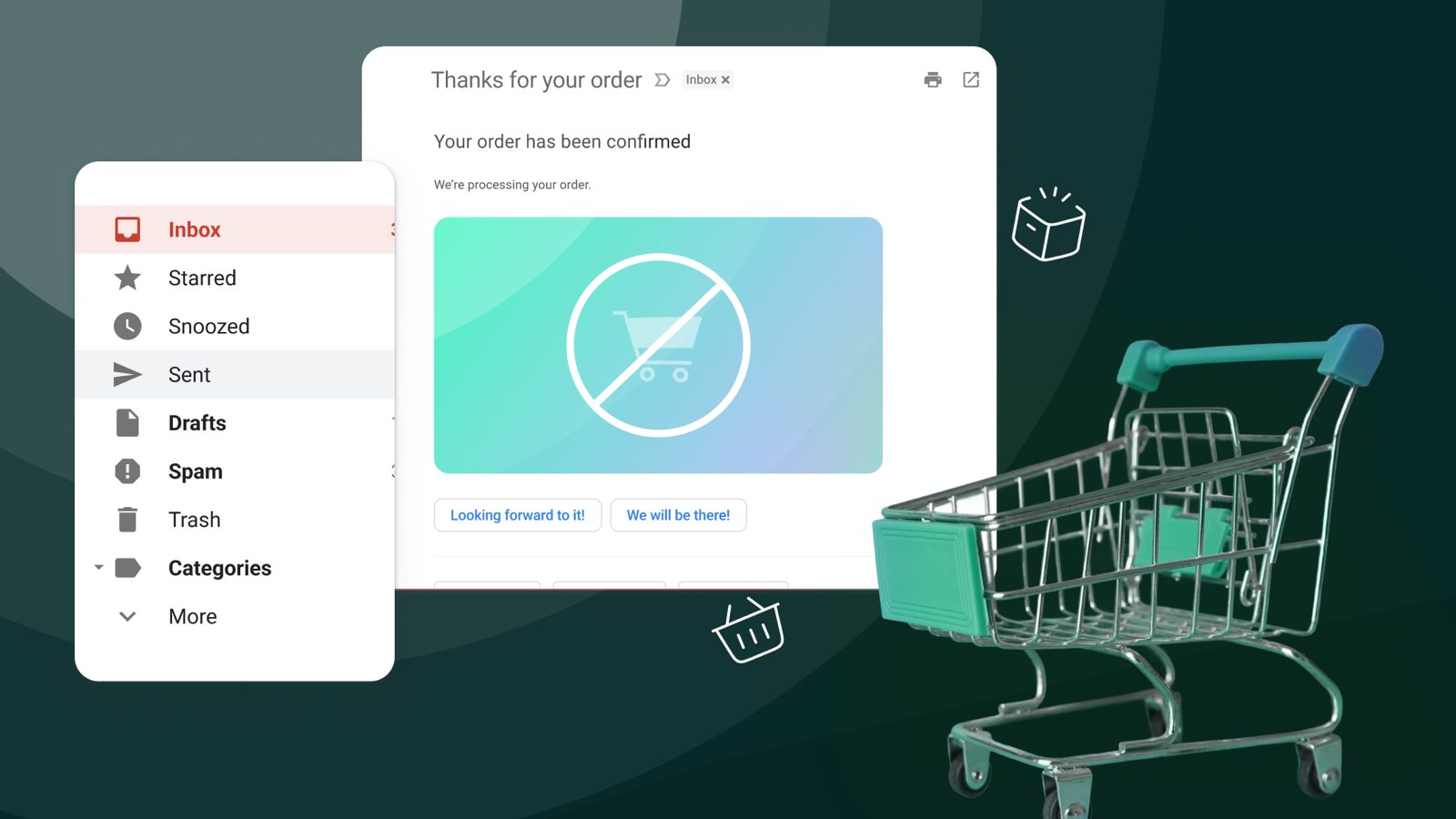
And yet, most post-purchase emails I see in ecommerce look something like this:
Subject line:Thanks for your order
Preview text:Your order has been confirmed
Email body: “We’re processing your order.”
Here’s your receipt.
Now, here’s a vague shipping promise.
Oh, look… a button nobody needs.
Maybe a limp product block shoved in at the bottom because someone said “cross-sell” in the last all-hands meeting.
Yes, this gets the job done… technically. So does a metal folding chair in the middle of a living room. But neither are exactly designed as an optimized experience.
That’s the missed opportunity I want to talk about with you today.
A world-class post-purchase email does a lot more heavy lifting than most ecommerce brands give it credit for, because it’s your first chance to:
- Reinforce trust after the transaction
- Answer the questions that start forming the second someone clicks Place Order
- Keep the energy of the purchase from falling flat
- Make the customer feel like they bought from a brand that still sees they’re a human being, rather than a wallet with a pulse
And because customers are paying such close attention in this window, it’s also one of the clearest opportunities ecommerce brands have to deepen the relationship and, when done well, drive additional revenue in a way that feels organic for customers.
So that’s what we’re going to get into today: what a post-purchase email today actually needs to include, what it should be doing beyond confirming the order, where brands keep fumbling the moment, and how to write one that leaves the customer feeling informed, reassured, and still glad they bought from you in the first place.
Your post-purchase email is doing emotional work whether you planned for it or not
A post-purchase email doesn’t just deliver information. It shapes how the customer feels about the purchase they just made.
That’s true whether you write for it or not:
- If your email is clear, grounded, useful, and a little warm, it reinforces confidence.
- If it sounds sloppy, cold, generic, or weirdly over-eager, it can introduce friction into a moment that should feel smooth.
- If it leaves obvious questions unanswered, it creates work for the customer.
- If it creates work for the customer, it creates doubt.
- If it creates doubt, congratulations, you have managed to make the moment after the sale less stable than it needed to be.
Sure, your customer has already done the hard part: they didn’t abandon their cart, they actually completed the purchase! Now they want to know what happens next, whether the order is in good hands, and whether your brand still feels competent once the money has gone through.
🔎 Go deeper:What is performance marketing? (definition + ecommerce examples)
That’s why strong post-purchase emails do more than confirm the transaction. They reduce uncertainty, reinforce the decision, and make the next step feel clear.
They answer the obvious next questions before those questions become anxiety:
- When is this shipping?
- What should I expect?
- Did the order go through correctly?
- What happens if I need help?
- What do I need to know to get the most out of what I just bought?
That’s what a useful post-purchase email starts doing right away.
But wait, there’s more!
So what does every post-purchase email in 2026 actually need?
There are a few things every good post-purchase email should include, and the first one is painfully unsexy:
1. Clear confirmation that feels grounding, not robotic
Yes, the customer needs the basics. Order confirmation. Item summary. Shipping details. Billing details if relevant. Contact information.
That’s the baseline.
From there, the email should still sound like your brand in a way that feels natural and human to the customer. The tone should carry through. The message should feel specific to what they just bought. The whole thing should leave them with the sense that everything is in order and the next step is clear.
A little grounding also goes a long way here. “We got your order.” “You’re all set.” “We’re on it.” “Here’s what happens next.” Language like that helps the customer settle. It lowers the temperature in a good way. It tells them the handoff worked.
That’s more valuable than people think.
2. A clear “what happens next” section
This is one of the biggest misses I see all the time.
Brands confirm the purchase, then vanish into a fog of “you’ll receive another email when your order ships,” which is technically fine and emotionally unhelpful. But your customer is now sitting there wondering if that means later today, tomorrow, next week, or sometime before the inevitable heat death of the universe.
🔎 Go deeper:Ecommerce SEO agency vs. DIY Shopify SEO (fixes that move rankings)
So, tell them what happens next with specificity:
- Tell them when processing usually takes place.
- Tell them when they can expect a shipping update.
- Tell them if fulfillment takes longer because the item is made to order, backordered, pre-sale, or shipping from somewhere that requires a little patience and a prayer.
- Tell them what to do if they need help changing an address or correcting something quickly.
Customers are astonishingly forgiving when they know what’s going on. What makes them twitchy and annoyed are vague expectations and bad communication.
3. A reason to feel good about the purchase
This is where a lot of ecommerce brands accidentally leave money on the table.
You don’t need to throw a parade for your new buyer, complete with a confetti cannon. But you do need to reinforce the choice.
- If the customer bought your sheets, remind them what they’re about to sleep on.
- If they bought cookware, remind them why this set is worth having in their kitchen for the next decade.
- If they bought skincare, remind them what the product is going to help them do.
- If they bought supplements, remind them what consistency gets them.
- If they bought something indulgent, beautiful, or joyful, let them keep feeling that.
The customer has already said yes. They’re primed. This is a great moment to strengthen the emotional logic of the purchase while it’s still warm.
How does this help you set the table for future purchases?
Because a customer who still feels good about the decision they just made is a lot easier to sell to later.
That post-purchase moment is where you reinforce taste, judgment, and trust. You’re helping the customer settle into, “Yes, I’m glad I bought this.” Once that feeling is there, the next email encouraging future purchases has a much stronger foundation.
📊 Case study:How an ecommerce brand turned a performance marketing problem into a growth reset
The customer feels smart. The product feels promising. The brand feels like it knows what it’s doing. From there, cross-sells feel more relevant, replenishment reminders feel more natural, and the next offer lands on warmer ground.
4. Product-success guidance
This one matters more today because customers now expect more from ecommerce brands to help them succeed with what they bought.
Not every category needs a huge onboarding sequence, obviously. A candle probably does not require a field manual. Although, based on some of the candles I’ve purchased, I would appreciate emotional aftercare and a small choir.
But if your product has any learning curve, setup process, usage best practice, fit guidance, ingredient story, care instructions, timing expectation, or “here’s how to get the most out of this” angle, your post-purchase email should start that work early.
- This reduces support tickets.
- It reduces confusion.
- It reduces return risk.
- And it makes the customer more likely to get the result they wanted when they bought.
That last point is massive. The easiest way to increase repeat purchase is to help the first purchase go well.
I know. Very glamorous insight. Still true.
5. An easy path to support
If a customer needs help after buying, help should feel easy to reach.
That doesn’t mean shoving “contact us!” in giant red text across the middle of the email like an ambulance siren. All you need to do is make support visible, calm, and frictionless. It means answering obvious questions where you can, and making the next step clear if you can’t.
🔎 Go deeper:How to structure PPC campaigns for profit
Remember, buyers don’t enjoy feeling like a brand got very talkative during the seduction phase and then suddenly became evasive once commitment entered the picture.
That’s how trust dies.
6. A thoughtful next step
A lot of teams hear “post-purchase email is valuable” and immediately turn into overeager sales goblins. The customer just bought a thing and now the brand is already lunging across the table with six more.
Easy.
Yes, the next step matters. The timing matters more.
Sometimes the next step is no additional sale at all. Sometimes the right move is simply a good experience and a clear path to success.
Sometimes, though, a thoughtful next step absolutely belongs in the post-purchase flow: a care guide, a styling suggestion, a related product that genuinely helps, a subscription option, a referral moment, a prompt to download the app, a way to join the loyalty program, a useful piece of content, a cross-sell that makes actual sense.
What do all of those options have in common? They’re thoughtful, contextual, and purposeful.
If the recommendation feels like it grew naturally out of what the customer just bought, great. If it feels like someone in retention got a little too eager and decided every transaction needs an immediate upsell, maybe take a walk and come back later.
How ecommerce brands often screw up the post purchase email
These are the most common that I see:
- They write the email like the customer’s only need is proof that the order exists. By now, you know why this is a problem. Yes, they need confirmation. They also need orientation, confidence, and a sense that the brand still knows how to talk once the conversion pixel fires.
- They over-sell too soon. The customer buys one thing and immediately gets hit with “you may also like” energy so aggressive it feels like being followed around a department store by someone on commission. The timing feels off because it is off.
- They make the whole email about the brand’s systems instead of the customer’s experience. Lots of internal-process language. Lots of “your order is being processed.” Lots of talking around the customer instead of to them. You can practically hear the software writing it.
- They let the email flatten the emotional high of the purchase. This is especially painful in categories where the brand worked hard to build desire, aspiration, comfort, excitement, transformation, or delight before the sale, only to send a post-purchase email that sounds like a parking permit.
- Finally, they waste the moment entirely.No product guidance. No useful next step. No thought about what the customer is feeling. No attempt to reduce remorse or increase success. Just “thanks, your order is confirmed.” Great. Inspiring. Goosebumps.
Now it’s time to look at your emails. And I need you to be brutal.
🔎 Go deeper:Full service agencies vs. specialized agencies (pros + cons)
Ask yourself:
- Does the first email feel like your brand is talking to a live human being or a system talking to a ticket number?
- Does your customer clearly know what’s going to happen next and when?
- Are you giving your customer any reason to feel good or excited about what they just bought?
- Are you setting your customer up for product-success before they even receive it?
- Does the next step make sense, or does it come across as overeager?
And finally, here’s my favorite question:
If you were your own customer receiving this email, would you feel taken care of or processed?
Post purchase email examples for ecommerce
Let’s say you sell wellness supplements
The customer has just bought a sleep gummy, a greens powder, or some adaptogen blend they’re fully prepared to believe is going to help them become the kind of person who hydrates properly, wakes up clear-eyed, and maybe even answers texts on time.
A weak post-purchase email confirms the order and disappears.
A stronger one:
- Confirms the order, and tells them when to expect it
- It also gives them one useful note that helps them feel smart and steady about the purchase: when to take it, what to expect, how long it usually takes to notice a difference.
That kind of guidance builds trust fast, because it makes the brand feel like it cares whether the product actually succeeds once it gets to the customer.
Now let’s imagine you sell skincare
You’re the holder of the serums, moisturizers, masks, cleansers, and all the little bottles and jars people buy with a mix of hope, skepticism, and an extremely sincere desire to look better lit from within. Or at least achieve glass skin after the age of 35.
🔎 Go deeper:How to write cart abandonment emails that don’t suck (+ examples)
A weak post-purchase email acts like the product will explain itself when it arrives.
A stronger one:
- Confirms the order, gives a realistic shipping window.
- Then it starts setting up the customer for success.
It might tell them where the new serum fits in their routine, whether the moisturizer plays nicely with actives, or how often they should actually use the mask they bought. Nothing too heavy. Just enough to make the customer feel looked after instead of left alone with a shelf full of expensive chemistry and their own unrealistic expectations.
Behold, the post-purchase sequence (because one email is rarely enough)
This is another place where brands get too literal.
They hear “post-purchase email” and think one confirmation email is the whole category. It isn’t. For a lot of brands, post-purchase should be a sequence, even if it is a short one.
- The first email is the immediate confirmation. That one needs clarity, confidence, and expectations.
- The second email, depending on timing and category, may be a shipping update or an educational touchpoint that helps the customer know what to expect.
- The third may be product-use guidance, care instructions, setup help, or an early cross-sell if that truly fits the product.
- Later emails may handle review requests, replenishment, referral, loyalty, second purchase, subscription, or win-back.
The point is that the post-purchase experience isn’t one message. It is a stretch of relationship-building where each message should know why it exists. And that first email you send (you know, the one with the 17% higher open rate) sets the tone for the entire email sequence.
If every email in the sequence is doing the same thing, or if none of them are doing much of anything beyond moving data around, you are underusing one of the strongest periods of attention you are ever going to get from a customer.
So what does a strong post-purchase email actually do?
It makes the customer feel like they bought from people who have thought past the checkout button.
That’s the bar you need to clear as an ecommerce brand.
A good post-purchase email settles the obvious questions fast, keeps the tone of the brand intact, and gives the customer something useful to hold onto while they wait. Sometimes that is clarity. Sometimes it is reassurance. Sometimes it is product guidance. Sometimes it is a very well-judged next step.
What it should never feel like is a dead zone between conversion and delivery where the brand suddenly forgets how to talk.
📊 Case study:How an ecommerce brand turned a performance marketing problem into a growth reset
That’s why this email matters so much more than teams often treat it. The customer is still paying attention here. They’re still deciding what this purchase feels like, and learning what kind of brand you are once the money has gone through and the performance team has moved on to the next problem.
So go look at your post-purchase emails with a little less affection and a little more honesty. Read them like a customer who just spent real money and now wants to feel taken care of, not processed. See whether the message gives them confidence, orientation, and a reason to stay warm on the brand. Evaluate if it sounds like a person wrote it on purpose. Decide if it earns its place in the experience or just exists because Shopify spat it out.
Because today, the order confirmation isn’t the end of the story. It’s your first chance to prove the brand still has a brain after the sale.